
The central question is a different one: does the AI reliably find the right passage without having to read large parts of your material? As long as the answer is “yes”, you usually do not need RAG. How you notice that this is changing is what this article is about – using two filing systems that hold the same knowledge and are still worlds apart to work with.
Why the question of volume misleads
One reason for this is new: modern AI models read a remarkable amount at once. Current top models process around one million tokens per request (Anthropic) – that is roughly 1,500 pages.
Whatever fits into that window you can, in principle, simply send along. So as a starting point: for small and medium-sized collections you usually do not need RAG. “Usually”, because volume is not the only factor: cost per request, access rights and response time can argue against it even with small collections. We will come back to that below.
But the number alone does not carry you far. Two collections of the same size can be completely different to work with.
The factor that really counts: how well ordered is your material?
Picture two filing systems side by side that hold the same knowledge:
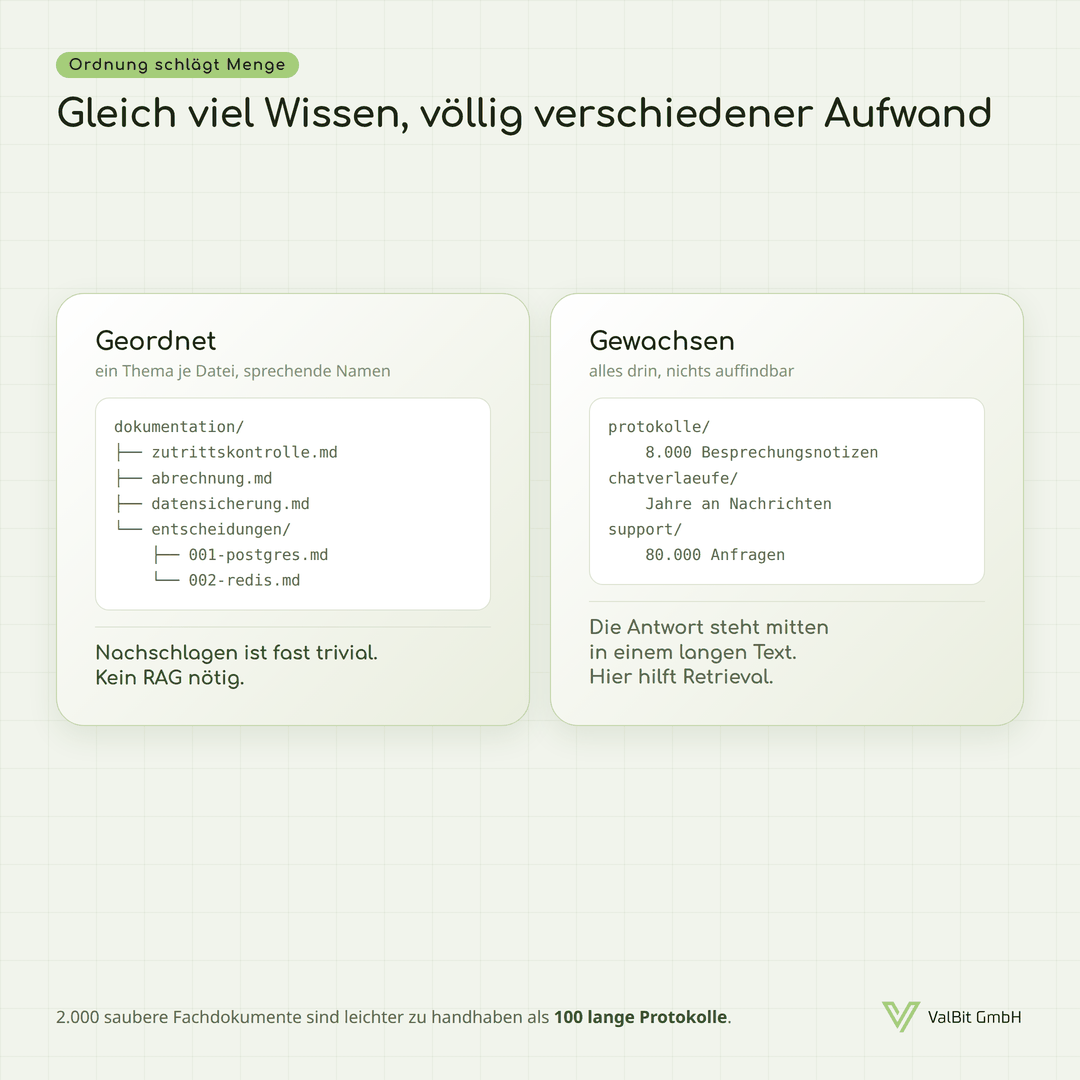
In the ordered system looking things up is almost trivial: the file name alone tells you where something is. An AI with access to the files finds the right one without you building any technology around it. In the one that has grown over time, the same answer sits somewhere in a paragraph in the middle of a long set of minutes, with nothing in a file name to hint at it. This is exactly what retrieval is made for.
The difference has a name: information density. Two thousand small, cleanly named subject documents are easier for an AI to handle than a hundred long, unstructured sets of meeting minutes – even though the second collection looks far smaller by file count.
A practical rule of thumb
What gets counted here is documents, not data volume:
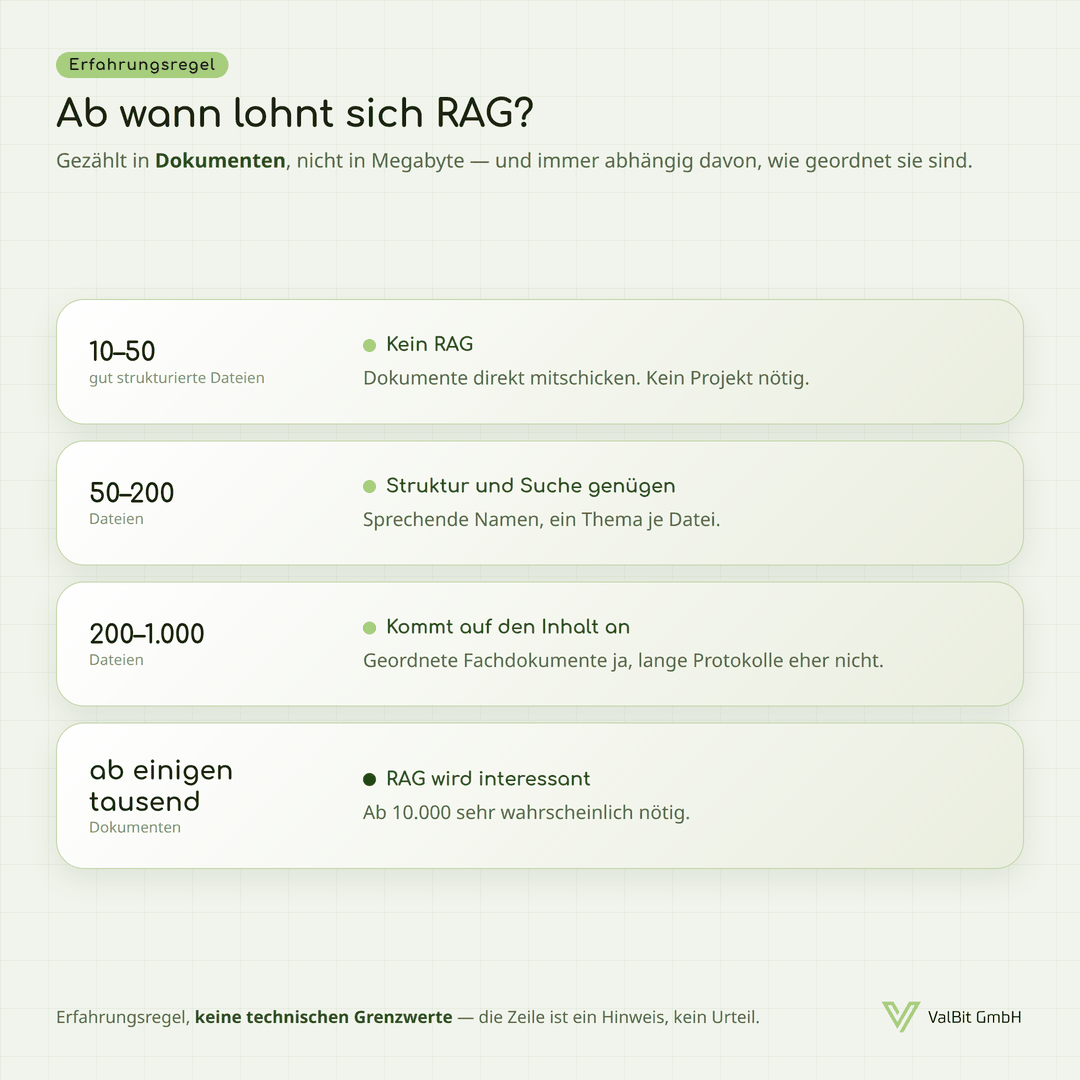
Broadly speaking: below around 200 well-structured files the effort rarely pays off, from a few thousand documents retrieval becomes interesting, and from 10,000 it is very probably needed. These are not technical thresholds but a rule of experience.
Signals that argue for RAG
More telling than any tier is whether several of these points apply to you. The list is not exhaustive; it names common signals:
- A lot of long, unstructured text – minutes, chat logs, support enquiries, email threads.
- Knowledge sits in several places and nobody is sure where the current version is.
- The material changes frequently, so keeping it up by hand cannot keep pace.
- People ask by paraphrasing, not with fixed terms (see part 2).
- Filters matter – this project only, this year only, only what this employee is allowed to see.
- Ordinary search returns too many hits, or the AI noticeably spends time and money just finding the information in the first place.
The last signal is the most reliable one. If you observe that the AI regularly fails to find the right passage – then the moment has come.
As long as the right passage is found without any technology, RAG is a solution to a problem you do not have. Only when searching itself becomes the bottleneck does the effort pay off.
Questions of economics
Even when the volume argues for RAG, it is the usage that decides whether it pays. Four questions tend to be the most productive – depending on your business, others come on top, such as requirements from your industry or certification:
- How often are questions asked? Sending the whole collection with every question costs money – every time. At ten questions a day nobody notices; at a thousand they do (SitePoint, KeepMyPrompts).
- Is the material growing? An archive that grows month by month will eventually outgrow any context window.
- Is everyone allowed to see everything? If not, there is hardly a way around a solution with rights management.
- How fast does it have to be? Five passages found on purpose are processed in seconds; a thousand pages are not.
Our recommendation: tidy up first, then upgrade
The most effective first step is rarely a technical one. Before you start a retrieval project, the simpler exercise is almost always worth it:
- Create structure – meaningful file names, one topic per document, clear folders.
- Set up a signpost that says on a single page where which knowledge lives.
- Work with it and watch where things get stuck.
- Only then add retrieval – where searching is demonstrably the problem.
It is worth noting that professional AI tools work to this very pattern themselves: a compact overview file as the way in, with detailed topic files loaded when needed (Anthropic: Claude Code Memory).
A tidy collection makes every later RAG project better – and sometimes unnecessary.
What comes next
The next part is about the tools: what is out there, what of it is free of charge and which items still tie up money.
Sources
- Anthropic model overview – context windows of current models (1 million tokens)
- Long Context vs RAG (SitePoint) · 1M Context Windows Are a Trap (KeepMyPrompts) – cost per request, latency, permissions
- Claude Code: How Claude remembers your project – compact overview file as the way in, detail files when needed
- The document rule of thumb and the list of signals follow an engineering assessment from practice (research by Wolfgang Duttlinger, 14 August 2026) – deliberately marked as a rule of experience, not as a measured value.